Most guides on this topic are already out of date. Arc Raiders’ anti-cheat setup has changed twice this year, and neither change made it into the guides still ranking for this search.
Here’s the current stack: Easy Anti-Cheat, Anybrain’s AI layer, a fully deployed Denuvo Anti-Cheat, and a three-strike ban system, all confirmed against Embark’s own patch notes.
Table of Contents
- What Anti-Cheat Does Arc Raiders Use?
- Denuvo Anti-Cheat Rollout Timeline
- How the Ban System Works
- What to Do If You Think You Were Wrongly Banned
- The Abnormal Match Compensation System
- Accessibility Devices vs. Cheat Devices
- Common Types of Cheats Detected
- Why Free Cheat Downloads Are Especially Risky
- Key Takeaways
- FAQ
What Anti-Cheat Does Arc Raiders Use?
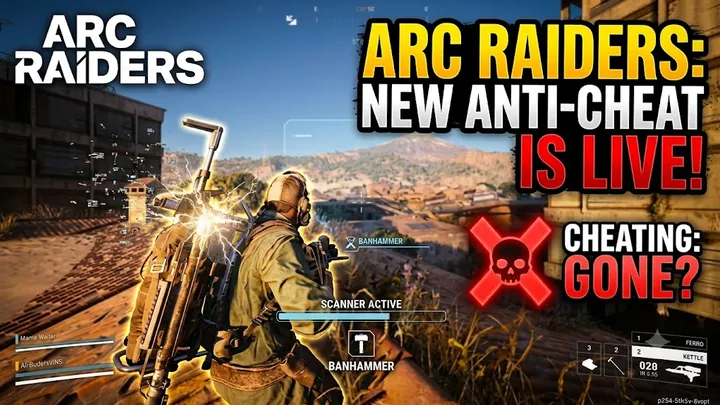
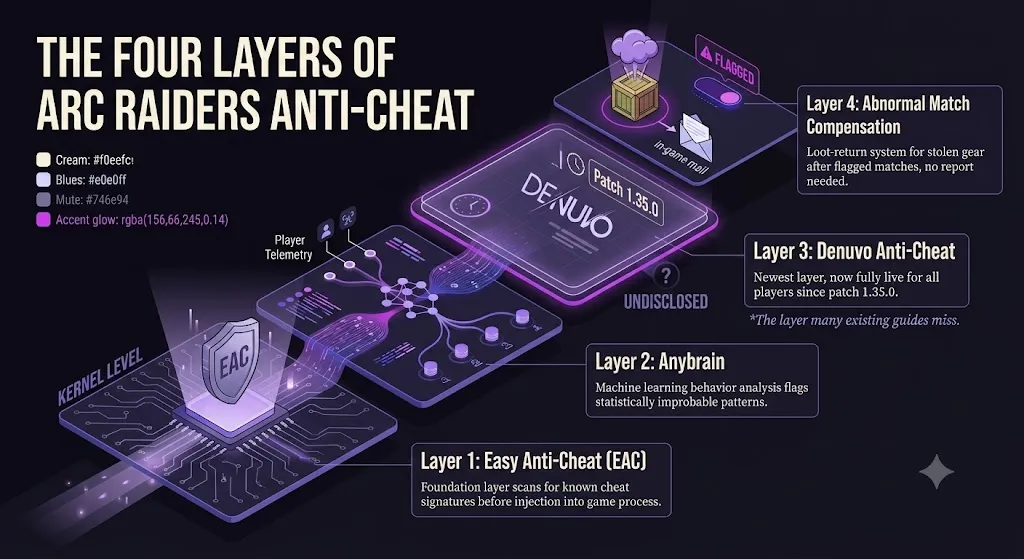
As of the current patch, Arc Raiders runs four layers together.
Easy Anti-Cheat (EAC) sits at the kernel level, the foundation layer that scans for known cheat signatures before they can inject into the game process.
Anybrain adds machine learning behavior analysis on top of EAC, trained on player telemetry to flag statistically improbable patterns rather than just known cheat files.
Denuvo Anti-Cheat is the newest layer, and it’s also the one most existing guides miss entirely. It’s fully live for every player as of patch 1.35.0.
Abnormal Match Compensation is a loot-return system. Players have reported getting stolen gear back through in-game mail after a match gets flagged, without needing to file a report.
Embark hasn’t published a detailed breakdown of exactly how this system decides what counts as an abnormal match, so treat the specifics as community-observed rather than officially documented.
Embark has described anti-cheat as a studio-wide effort that combines kernel-level protection from Easy Anti-Cheat with machine-learning detection trained on player telemetry, with additional undisclosed layers behind those two for operational security.
Denuvo Anti-Cheat Rollout Timeline
Denuvo’s rollout happened in two stages, and the exact dates matter if you’re trying to figure out whether it was active during a match you’re asking about.
| Date | Patch | What Happened |
|---|---|---|
| May 19 | 1.29.0 | Denuvo Anti-Cheat begins rolling out to a limited player pool |
| June 30 | 1.35.0 | Rollout completed to all players |
The rollout followed a positive result from a similar deployment in The Finals, Embark’s other live-service shooter.
Embark has been explicit that this is not a DRM deployment. The studio confirmed it is not using Denuvo’s Digital Rights Management service and is working to keep the performance impact minimal, addressing the most common complaint tied to Denuvo’s brand.
By June 30, Embark’s own update notes stated the rollout was complete for all players and that the team was watching for impact and performance issues going forward.
How the Ban System Works
Arc Raiders uses a three-strike progressive ban system, introduced in patch 1.13.0 on January 27:
- First offense: 30-day ban
- Second offense: 60-day ban
- Third offense: Permanent ban
This applies broadly to fair play violations, not exclusively to cheating in the aimbot-and-wallhack sense.
Why Some Players Think the System Is Too Soft
The most common criticism since launch is straightforward: a 30-day first strike doesn’t feel like a real deterrent next to games where a confirmed cheater gets an immediate permanent ban. Players comparing Arc Raiders to stricter extraction shooters point out that a month-long suspension still lets a repeat offender return to the same lobbies, on the same account, with nothing lost but time.
The counterargument, and the likely reason Embark built the system this way, comes down to false positives. Anybrain’s detection is behavior-based, not purely signature-based, which means it’s built to flag statistical outliers, not just known cheat software.
A player on an unusual hot streak, a high-refresh-rate monitor user with genuinely fast reaction times, or someone running uncommon accessibility hardware can all produce the kind of pattern the system is watching for.
A graduated system gives Embark room to correct a wrong call before it costs someone their account permanently, at the cost of feeling lenient toward players who are guilty on the first offense.
It’s worth noting Embark hasn’t published the criteria that separates a “first offense” ban from an instant permanent one, so severity may already factor in behind the scenes even though the public-facing structure reads as a flat three strikes for everyone.
What to Do If You Think You Were Wrongly Banned
If you’ve been restricted and believe it was a mistake, Embark’s support process is fairly specific about how to handle it.
-
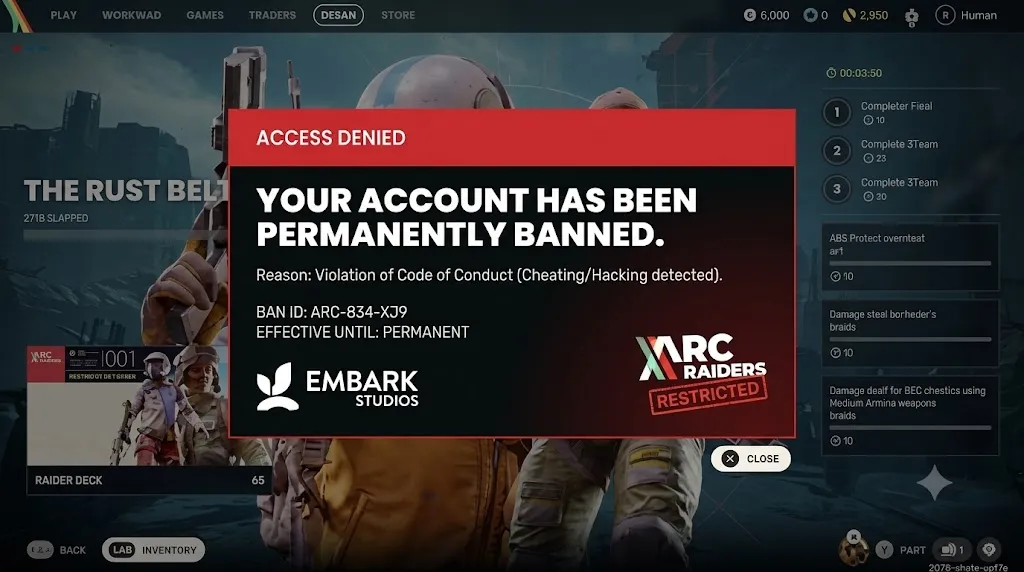
Check whether it’s a hardware restriction first. Hardware bans are final and cannot be appealed under any circumstances. Everything below applies to account-level bans only.
-
You get one appeal per restriction. There’s no benefit to submitting multiple appeals or follow-up tickets before you hear back. It won’t speed up the review, and Embark has noted repeated submissions can slow the process down instead.
-
Submit through the official Support page, not through Steam, console storefronts, or social media. Log in with your Embark ID, open the chat bubble, and select Ban Appeals.
-
Include everything relevant up front, since you don’t get a second attempt: your platform, the date of the ban, the exact error message or restriction notice you received, and a clear, specific explanation of what you were doing at the time. Vague appeals that just assert innocence without detail are harder for a reviewer to act on.
-
Expect one of three outcomes. Embark’s stated process resolves every appeal as either upheld (the restriction stands), adjusted (the penalty changes based on severity), or lifted (the restriction is reversed because it was applied in error). A person on Embark’s team reviews each case individually rather than an automated system rubber-stamping the original decision.
-
Don’t expect detection details in the response. Embark has stated it won’t share the specific methods or evidence behind a ban, to protect the anti-cheat system’s integrity. An appeal outcome without a technical explanation isn’t a sign the case wasn’t actually reviewed.
If you play through Steam Family Sharing, it’s also worth knowing that enforcement actions can affect every account using the shared license, not just the one that triggered the flag.
The Abnormal Match Compensation System
If a cheater kills you and takes your gear, Embark’s system is designed to eventually give it back. Once a match gets flagged for abnormal circumstances, typically after a confirmed cheater is identified, affected players get their lost items returned through in-game mail.
A few things worth knowing:
- It appears to run automatically, without requiring a manual report
- Players have reported turnaround times of around 24 hours, though this isn’t officially documented
- It’s a recovery system, not a prevention system. It doesn’t stop cheating, it softens the cost of running into it
This is one of the more distinctive choices Embark has made compared to other extraction shooters, which tend to treat lost loot as gone for good once a match ends.
Accessibility Devices vs. Cheat Devices
This is the part almost no other guide covers, and it’s a genuinely useful distinction if you use any kind of accessibility hardware to play.
Embark has acknowledged that accessibility devices create a hard problem for anti-cheat systems. The same category of hardware that helps a player with limited mobility play the game can, in the wrong hands, be used to cheat.
The signal Embark says it actually cares about is intent, analyzing telemetry and communication patterns to distinguish legitimate accessibility use from abuse, rather than banning based on the hardware itself.
Officially licensed accessibility devices from major platforms are the easiest for Embark to recognize and clear. Lesser-known or off-brand devices are harder to distinguish from cheat tools, and Embark has said this detection is an ongoing area of refinement rather than a solved problem.
If you use adaptive hardware and get flagged, Embark’s support channel is the way to report it and have your setup reviewed manually.
Common Types of Cheats Detected
The anti-cheat stack is built around a few recurring cheat categories:
- Aimbots: Automated aim assistance that locks onto targets, often through walls or at inhuman reaction speed
- Wallhacks/ESP: Reveals enemy positions, loot, or movement through solid objects
- Speed hacks: Movement manipulation that lets a player cross the map faster than the engine allows
Anybrain’s behavior layer is specifically built to catch patterns that don’t rely on a known cheat signature, like perfect headshot chains or movement that doesn’t match human reaction times, which is why it works alongside EAC rather than replacing it.
Why Free Cheat Downloads Are Especially Risky
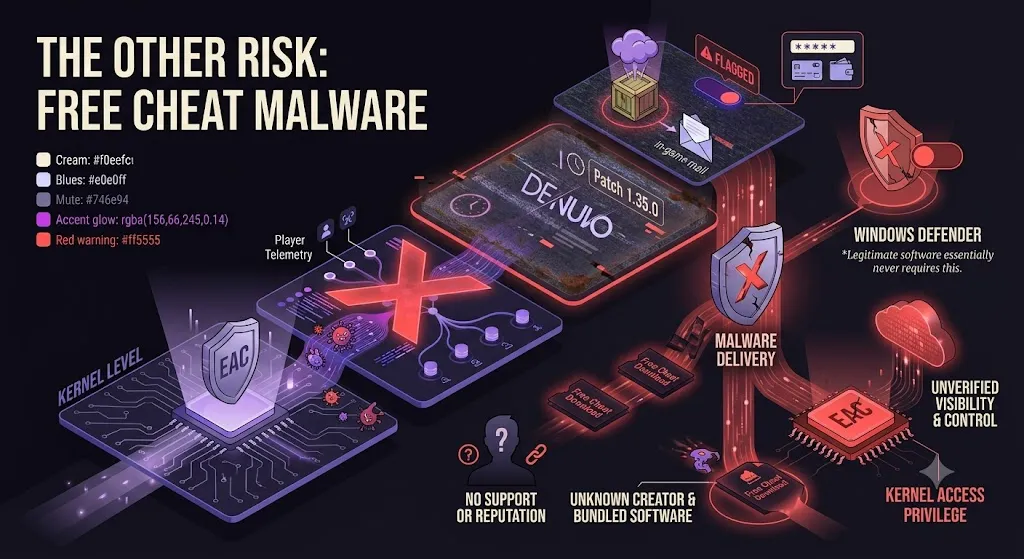
Anti-cheat bans aren’t the only risk tied to cheat software. Free cheat downloads are one of the most common malware delivery methods in PC gaming, and that risk exists independently of whether Arc Raiders’ detection ever catches the cheat itself.
A few patterns show up consistently across the cheat ecosystem, not just in Arc Raiders:
-
Free cheats are frequently used to distribute infostealers and remote access trojans (RATs). These are built to quietly harvest saved passwords, browser session data, and linked payment or wallet information, not just to give an aim advantage.
-
Most cheat tools ask you to disable antivirus or Windows Defender before installing. That’s a major red flag by itself. It’s the same step that makes a machine vulnerable to exactly the kind of malware described above, and legitimate software essentially never requires it.
-
Kernel-level cheats run with the same deep system access as kernel-level anti-cheat. A free tool asking for that level of privilege has full visibility into your system, and there’s no way to verify what it’s actually doing with that access once installed.
-
Free tools have no accountability. There’s no support channel, no reputation to protect, and often no way to know who built it or what else got bundled in alongside the “cheat” itself.
Key Takeaways
- Arc Raiders currently runs four anti-cheat layers: EAC, Anybrain, Denuvo, and the loot-return system
- Denuvo finished rolling out to all players on June 30 (patch 1.35.0), without any DRM component
- Bans follow a three-strike system: 30 days, 60 days, then permanent, though hardware bans skip straight to final
- You get exactly one appeal per restriction, submitted through Embark’s official Support chat
- Stolen loot can be automatically returned through in-game mail after a match is flagged
- Accessibility hardware is evaluated by intent and behavior, not blanket-flagged as cheat hardware
FAQ
What anti-cheat does Arc Raiders use?
Arc Raiders runs three layers together: Easy Anti-Cheat at the kernel level, Anybrain’s machine learning behavior analysis, and Denuvo Anti-Cheat, which finished rolling out to all players on June 30. A loot-return system also compensates players who lose gear to confirmed cheaters.
When did Denuvo Anti-Cheat come to Arc Raiders?
Denuvo started rolling out to a limited player pool on May 19 as part of patch 1.29.0. Embark completed the rollout to all players on June 30 with patch 1.35.0.
Does Arc Raiders use Denuvo DRM?
No. Embark has stated it is only using Denuvo’s anti-cheat component, not its digital rights management service, specifically to avoid the performance concerns DRM tools are known for.
How does the Arc Raiders ban system work?
Arc Raiders uses a three-strike progressive ban system introduced in patch 1.13.0. A first offense results in a 30-day ban, a second offense escalates to 60 days, and a third offense is a permanent ban.
Is the Arc Raiders ban system too lenient?
A portion of the community has argued the 30-day first strike is too soft compared to instant permanent bans in other extraction shooters. Embark has not announced changes to the tiered structure since introducing it.
What happens if a cheater steals my loot?
Players have reported getting stolen gear returned automatically through in-game mail once a match is flagged for abnormal circumstances. This appears to run without needing a manual report, though Embark has not published full details on the system’s rules.
Can accessibility devices get flagged as cheating?
Embark has said this is an active area of work. Its systems analyze telemetry and communication patterns to try to separate legitimate accessibility device use from abuse, rather than flagging the hardware itself.
What kinds of cheats does Arc Raiders detect?
The anti-cheat stack is built to catch aimbots, wallhacks, and speed hacks, along with statistically unusual behavior like inhuman reaction times or unnaturally consistent headshot accuracy.
Can I appeal an Arc Raiders ban?
Yes, unless it’s a hardware restriction, which is final. You get one appeal per eligible restriction, submitted through Embark’s Support chat under Ban Appeals, and a moderator reviews the case individually rather than through an automated process.
Is Arc Raiders’ anti-cheat kernel-level?
Yes. Both Easy Anti-Cheat and Denuvo Anti-Cheat operate at the kernel level, which Embark says is necessary because most commercial cheats run at that same level.