Going topside alone means you can’t split ammo runs with a squad.
It also means you can’t lean on a teammate when you pick the wrong weapon for the fight in front of you.
This list ranks Arc Raiders weapons by solo viability specifically: how easy the ammo is to keep stocked, how much you lose if you die with it, and how well a two-weapon loadout covers both ARC units and other raiders.
That’s a different question than “what wins the most PvP fights,” and it produces a different ranking than most general tier lists.
Table of Contents
- What “Best” Means for Solo Play
- Best Budget and Low-Risk Solo Weapons
- Best All-Around Weapons for Solo Runs
- [ARC vs. PvP: Two-Weapon Pairings for Solo Loadouts]> (#arc-vs-pvp-two-weapon-pairings-for-solo-loadouts)
- Ammo Economy for Solo Raiders
- When to Upgrade Your Solo Weapon
- [Confirmed Patch 1.39.0 Changes vs. Community Consensus]> (#confirmed-patch-1390-changes-vs-community-consensus)
- Anti-ARC Specialist Picks
- Stealth and Weapon Noise
- Key Takeaways
- FAQ
What “Best” Means for Solo Play
Most weapon tier lists rank guns for squad play, where damage output and PvP dominance carry the most weight because a teammate can cover your blind spots.
Solo changes the math.
Mobility, ammo availability, and how much you lose on death matter just as much as raw stats.
A weapon that tops a general PvP tier list can still be a poor solo pick if it burns through Heavy or Energy ammo you can’t easily replace on your own.
The same goes for a weapon that sets your whole loadout back if you lose it on a failed extraction.
Everything below is filtered through that lens.
Best Budget and Low-Risk Solo Weapons
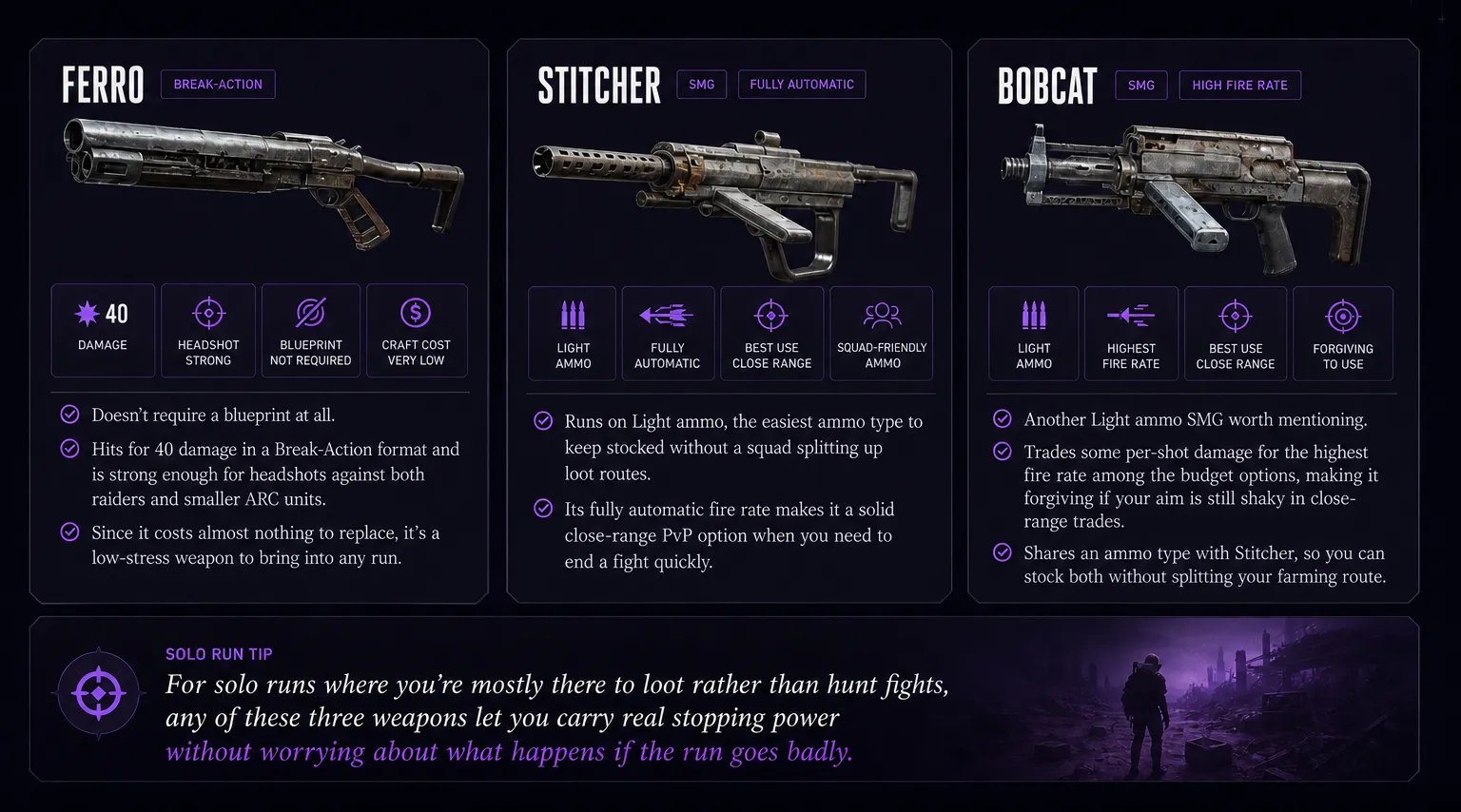
These are the weapons worth carrying when you don’t want a bad extraction to hurt.
Ferro doesn’t require a blueprint at all.
It’s cheap to craft, hits for 40 damage in a Break-Action format, and is strong enough for headshots against both raiders and smaller ARC units.
Since it costs almost nothing to replace, it’s a low-stress weapon to bring into any run.
Stitcher runs on Light ammo, which is the easiest ammo type to keep stocked without a squad splitting up loot routes.
Its fully automatic fire rate makes it a solid close-range PvP option when you need to end a fight quickly.
Bobcat is another Light ammo SMG worth mentioning here.
It trades some per-shot damage for the highest fire rate among the budget options, which makes it forgiving if your aim is still shaky in close-range trades.
Since it shares an ammo type with Stitcher, you can stock both without splitting your farming route across two ammo categories.
For solo runs where you’re mostly there to loot rather than hunt fights, any of these three weapons let you carry real stopping power without worrying about what happens if the run goes badly.
| Weapon | Ammo Type | Craft Cost | Replacement Risk |
|---|---|---|---|
| Ferro | Heavy | Very Low (no blueprint) | Very Low |
| Stitcher | Light | Low | Low |
| Bobcat | Light | Low | Low |
Best All-Around Weapons for Solo Runs
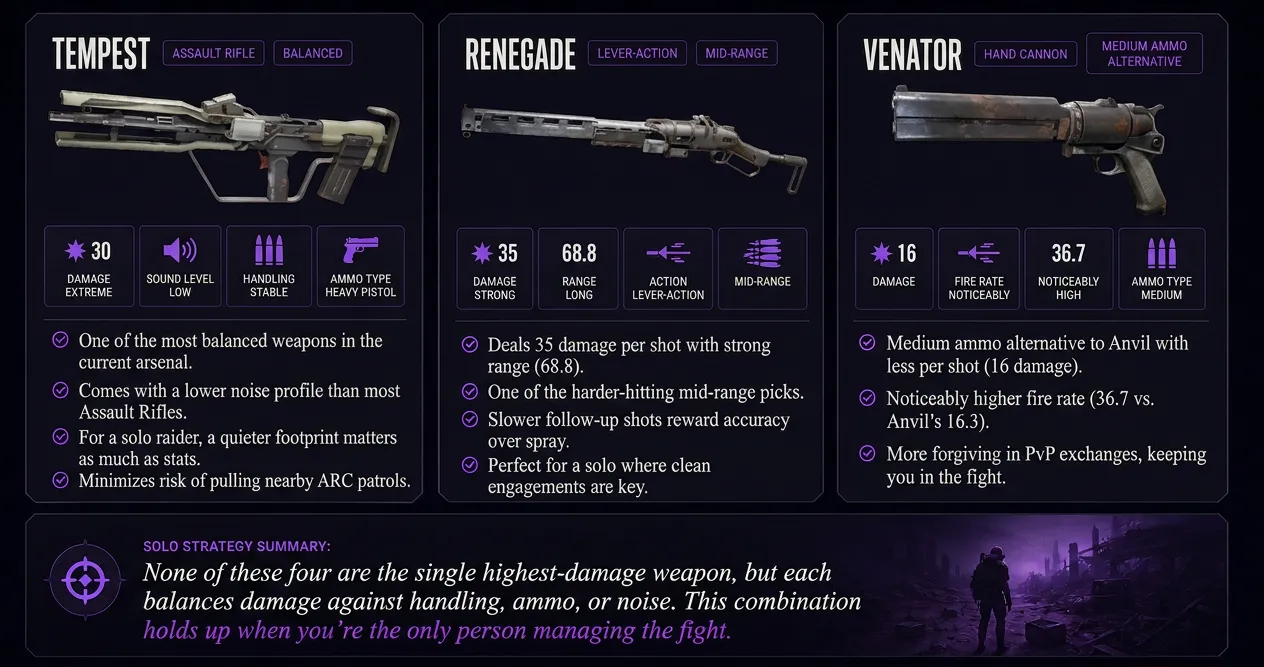
Tempest is one of the more balanced weapons in the current arsenal, and it comes with a lower noise profile than most Assault Rifles in its class.
For a solo raider, that quieter footprint matters as much as its stats.
A loud weapon can pull attention from a nearby ARC patrol or another raider while you’re mid-loot, and you won’t have a teammate watching your back while it happens.
Renegade deals 35 damage per shot in a Lever-Action format with strong range (68.8), making it one of the harder-hitting mid-range picks in the game.
Its slower follow-up shots reward accuracy over spray, which fits a solo playstyle where you can’t count on a teammate to clean up a missed engagement.
Anvil, a Hand Cannon dealing 40 damage per shot, is a reliable heavy-hitting sidearm that doesn’t demand the ammo commitment of a full primary weapon.
Venator is worth a mention as a Medium ammo alternative to Anvil.
It deals less per shot (16 damage) but has a noticeably higher fire rate (36.7 vs. Anvil’s 16.3), which makes it more forgiving in a straight PvP exchange where a missed first shot doesn’t end the fight immediately.
None of these four are the single highest-damage weapon in the game, and that’s the point.
Each one balances damage against handling, ammo availability, or noise in a way that holds up when you’re the only person managing the fight.
ARC vs. PvP: Two-Weapon Pairings for Solo Loadouts
This is the part most weapon guides skip: you only have two weapon slots, and no teammate to cover whichever threat your loadout doesn’t handle well.
Instead of picking weapons individually, pair them around ammo overlap and threat coverage:
Ferro + Stitcher. Ferro’s Heavy ammo handles ARC damage and hard-hitting PvP encounters, while Stitcher’s Light ammo covers close-range fights. Both are cheap enough that losing the pairing on a bad extraction barely costs you anything.
Tempest + Hullcracker. Tempest’s Medium ammo and lower noise handle general PvP and stealth looting, while Hullcracker’s Launcher ammo is dedicated to shredding ARC armor when you run into something bigger than a standard patrol.
Renegade + Anvil. Both use different ammo types (Medium and Heavy), so this pairing trades some ammo efficiency for two of the hardest-hitting per-shot weapons available, useful if you’re playing a slower, more deliberate solo style.
Bobcat + Osprey. A close-range Light ammo option paired with a long-range Medium ammo sniper covers both ends of an engagement, though it asks the most of your positioning skill since neither weapon is forgiving in the wrong range band.
Pick the pairing that matches how much ammo-farming time you’re willing to spend versus how much raw stopping power you want in each fight.
If you’re newer to solo play, start with Ferro plus Stitcher. It’s the most forgiving combination on this list, both in terms of ammo upkeep and what it costs you if a run goes wrong.
Ammo Economy for Solo Raiders
Without a squad to split loot runs, some ammo types are far easier to keep stocked than others.
Light and Medium ammo are common enough that most loot routes will keep you supplied without dedicated farming detours.
Heavy, Energy, and Launcher ammo are scarcer, and running dry on one of these mid-fight is a bigger risk when there’s no teammate to hand you a spare mag.
| Weapon | Ammo Type | Solo Farmability |
|---|---|---|
| Stitcher, Bobcat, Hairpin | Light | Easy |
| Tempest, Rattler, Renegade, Venator | Medium | Easy to Moderate |
| Ferro, Bettina, Anvil | Heavy | Moderate |
| Jupiter, Equalizer, Aphelion | Energy | Difficult |
| Rascal, Hullcracker | Launcher | Difficult |
| Il Toro, Vulcano | Shotgun | Moderate, narrow use case |
Shotguns are worth a specific note.
Il Toro and Vulcano both hit hard at close range, but their effective range (20 and 26 respectively) is far shorter than Ferro’s 53.1 or Tempest’s 55.9.
For a solo raider who can’t rely on a teammate to cover a bad-range engagement, that narrow window makes shotguns a riskier primary than the picks covered above.
They’re worth carrying if your playstyle is deliberately close-range and aggressive, but they didn’t make the core recommendations here for that reason.
If you’re building a loadout for a longer solo session rather than a quick in-and-out run, weighting toward Light and Medium ammo weapons reduces how often you have to break from looting to restock.
This matters more solo than it does in a squad.
In a team, one player can hang back and farm ammo while others push objectives.
Solo, every minute spent hunting down Heavy or Energy ammo is a minute you’re not looting, extracting, or repositioning away from a threat.
Weigh that cost against how much you actually need the extra stopping power for the specific run you’re planning.
When to Upgrade Your Solo Weapon
Upgrading a weapon at the Gunsmith costs materials you could otherwise spend elsewhere, so it’s worth being deliberate about which weapons earn the investment when you’re farming solo.
Budget weapons like Ferro and Stitcher are worth upgrading early since the material cost is low and the improvement is immediately noticeable in fire rate, reload speed, or durability, depending on the weapon.
Higher-rarity weapons are a different calculation.
If a weapon like Osprey or Hullcracker is going to sit in your stash more often than it’s topside, it’s not worth prioritizing upgrade materials over a weapon you’re actually running every session.
A reasonable solo approach: fully upgrade whichever two weapons make up your primary pairing before spreading materials across anything else in your stash.
Confirmed Patch 1.39.0 Changes vs. Community Consensus
It’s worth separating what’s actually confirmed by official patch notes from what’s just current community opinion, since tier lists shift with sentiment faster than the underlying weapon stats do.
Live Update 1.39.0, the current patch as of this guide, made no changes to weapon or combat stats.
It focused entirely on matchmaking adjustments, bug fixes, and a store update.
The last patch to actually move a weapon’s numbers was Patch 1.29.0 on May 19, 2026.
That means the current weapon data for Ferro, Tempest, Renegade, Anvil, and Hullcracker referenced throughout this guide has held steady across several patches, not just the most recent one.
Community tier lists disagree on exact placements from month to month regardless.
Some recent community rankings have put Tempest and Venator higher in earlier months than in more recent ones, and note that upgraded lower-rarity weapons like Ferro and Stitcher tend to overperform their base rarity in practice.
Treat placement-specific claims like these as community consensus rather than confirmed balance data, since they’re opinion aggregated across sources rather than tied to an actual patch note.
Anti-ARC Specialist Picks
Hullcracker and Equalizer are both strong against ARC units specifically.
Hullcracker deals 100 damage per shot in a Pump-Action format, the highest per-shot damage of any weapon covered here, and is built for tearing through ARC armor.
Neither is a strong standalone PvP weapon, though.
If you’re running solo and expect a fight-heavy session against other raiders, they work best as the second weapon in a pairing rather than your only loadout.
Equalizer deals less per shot than Hullcracker (8 damage) but fires fully automatic, making it better suited to sustained anti-ARC pressure over multiple encounters in a single run rather than a single burst kill.
It draws from Energy ammo, which is harder to keep stocked solo, so it’s best reserved for runs where you already know you’ll be dealing with heavier ARC presence, such as a session focused on a specific map zone with known ARC density.
Stealth and Weapon Noise
Weapon noise gets less attention in most tier lists because it doesn’t show up as a stat most players track closely, but it matters more when you’re solo than when you’re in a squad.
In a team, a loud weapon draws attention, but a teammate can reposition or cover you while you deal with it.
Alone, that same noise can pull a nearby raider or an ARC patrol into a fight you weren’t planning to have, with nobody to back you up.
Tempest’s reduced noise profile is one reason it shows up repeatedly in this guide.
Pairing it with a Silencer mod, when you have one available, extends that advantage further and can let you deal with drones or smaller ARC units before they detect your position at all.
If your solo playstyle leans toward looting quietly and avoiding fights rather than seeking them out, weighting your loadout toward quieter weapons is worth as much as raw damage output.
Osprey deserves a mention in this context too.
Its long range (80.3, the highest of any weapon covered in this guide) lets a solo raider deal with a threat before it closes distance at all, which fits the same avoid-the-fight logic as picking a quieter weapon.
Its Bolt-Action firing mode makes it a poor fit as your only weapon, but it pairs well with a fast-handling close-range option like Stitcher or Bobcat for the moments a fight closes distance anyway.
Key Takeaways
- Ferro and Stitcher are the safest low-risk picks since losing them barely sets you back.
- Tempest’s balanced stats and quieter profile make it one of the strongest all-around solo weapons.
- Build loadouts around two-weapon pairings that split ARC and PvP coverage rather than picking weapons individually.
- Light and Medium ammo are the easiest to keep stocked without a squad.
- Separate confirmed patch changes from community tier-list opinion before trusting a specific ranking.
FAQ
What’s the best solo starter weapon in Arc Raiders?
The Ferro is the strongest early solo pick. It doesn’t require a blueprint, costs almost nothing to craft, and hits hard enough for headshots against both raiders and smaller ARC units. You won’t feel much loss if you die with it.
Should solo players prioritize PvE or PvP weapons?
Neither exclusively. A solo raider only has two weapon slots and no teammate to cover the other threat type, so the strongest solo loadouts pair one weapon that handles ARC units with one that handles human opponents.
Is Ferro still good in Patch 1.39.0?
Yes. Ferro’s core stats and blueprint-free crafting haven’t changed in recent patches, and it remains one of the lowest-risk weapons to carry solo since losing it costs you almost nothing.
What ammo type is easiest to farm solo?
Light and Medium ammo are the easiest to keep stocked without a squad splitting up loot runs. Heavy, Energy, and Launcher ammo are scarcer and harder to maintain when you’re looting alone.
Is the Tempest good for solo play?
Yes. The Tempest is one of the more balanced all-rounders in the game, and its lower noise profile helps solo raiders avoid drawing attention from other players or nearby ARC units while looting.
What’s the safest weapon to carry if I don’t want to lose much on death?
Ferro and Stitcher are both cheap enough to replace that losing them on a bad extraction barely sets you back. Save your higher-value weapons like Osprey or Hullcracker for runs where you’re confident about extracting.
Can one solo loadout realistically handle both ARC enemies and other raiders?
Yes, but it requires deliberate pairing. A weapon like Ferro or Hullcracker for ARC damage paired with a fast-handling option like Stitcher or Tempest for PvP covers both threats without forcing you to farm three different ammo types.
Is Renegade worth using solo?
Renegade is a strong mid-range pick with high per-shot damage, but its Lever-Action firing mode means slower follow-up shots. It rewards accuracy over spray, which suits solo players who can’t rely on a teammate to clean up a missed engagement.
Are Hullcracker and Equalizer worth carrying solo?
Both are strong ARC specialists, but they’re weaker in straight PvP fights. Most solo raiders are better off carrying one of these only for runs where ARC damage is the priority, and switching to a PvP-capable pairing otherwise.
Does noise matter for solo weapon choice?
Yes. Without a teammate to watch your back, a loud weapon can pull unwanted attention from nearby raiders or ARC patrols mid-loot. The Tempest’s reduced noise profile is one of the reasons it’s a strong solo pick even outside of direct combat.